
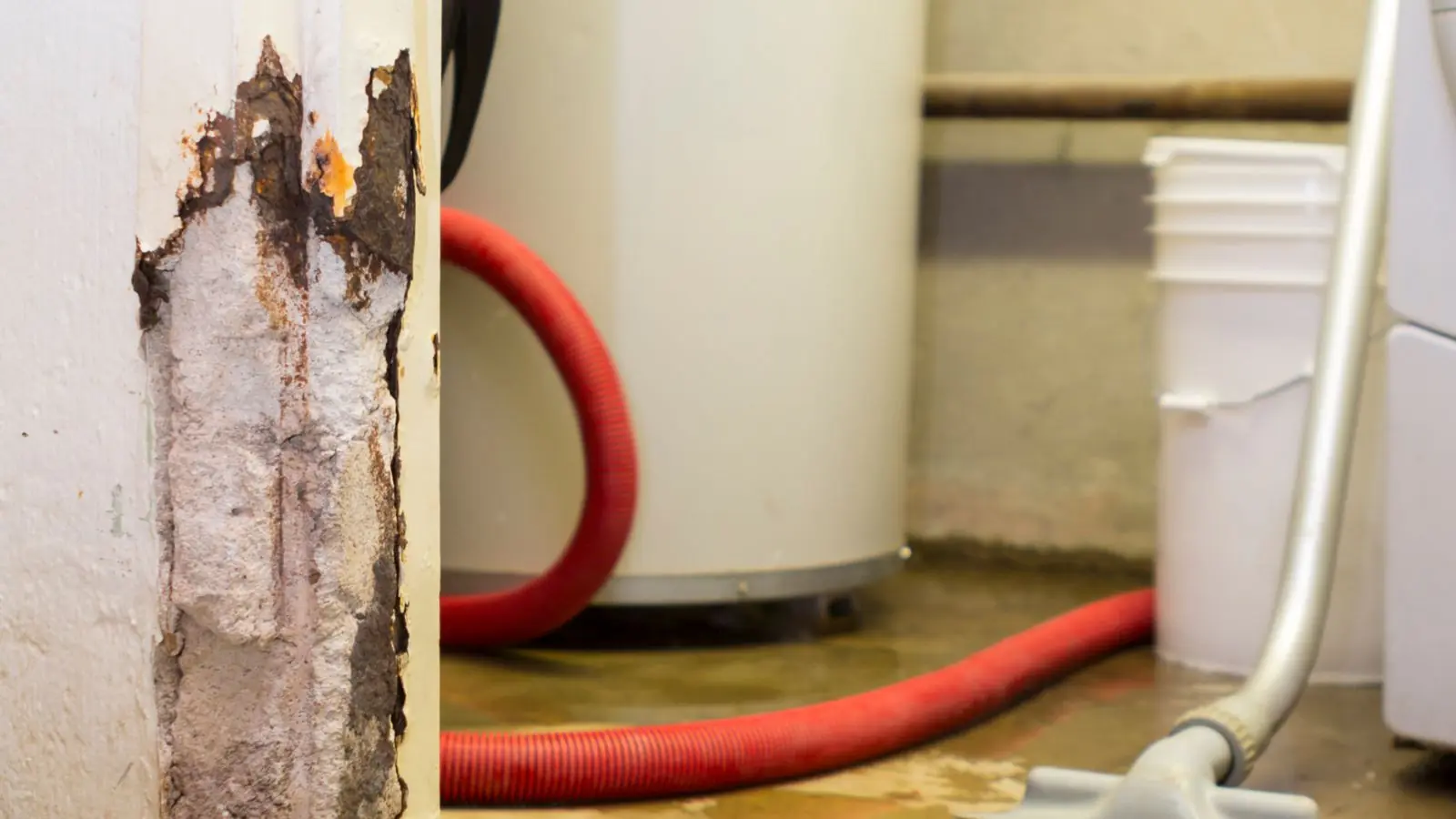
A leaking water heater can be a slow dark ring on the garage floor or a tank that empties 40 or 50 gallons across the room. Either way, the next hour is about stopping the water and keeping yourself safe, and the next two days are about drying before mold gets a start.
This guide covers the three common leak types, the shutoff steps for electric and gas units, what usually gets wet around a heater, how fast you need to dry it, and what to ask about permits and insurance.
Tank failure, slow leak or relief valve: which is it?
Water around a heater does not always mean the tank is done. Finding the wet spot's origin tells you whether you need a repair or a replacement.
| What you see | Likely cause | What it means |
|---|---|---|
| Water pooling under the tank from the bottom or sides, rust streaks | Tank has corroded through | Replacement. The tank cannot be repaired |
| Drips at the top, at the pipe connections or the shutoff valve | Loose or worn fittings, supply connections | Often a plumber's repair, if the tank itself is sound |
| Water from the pipe attached to the temperature and pressure relief valve | Valve opening because of high pressure or temperature, or a worn valve | Don't ignore. Call a plumber to check pressure, the expansion tank and the valve |
| Damp spot below a fitting that dries and returns | Slow seep from a fitting or the drain valve | Tighten or replace the part before it becomes a flood |
| Moisture on the outside of the tank only, in humid weather | Condensation | Dry it and watch. It is not a leak if the surface stays dry afterward |
A tank that is actively spraying or pouring is an emergency. A slow drip still deserves action the same day, because small leaks tend to grow.
Shut it down safely, in the right order
Do the shutoff at the unit, in a calm order. The water in the tank can be hot enough to scald, so keep hands and face clear of any spray.
- Cold water supply: close the shutoff valve on the pipe feeding the top of the heater, usually a handle or wheel. If it won't turn, close the main water valve for the house.
- Electric heater: turn off its breaker only if you can reach the panel without standing in water. If the floor around the panel is wet, don't go near it. Call the utility or 911.
- Gas heater: turn the gas control knob to the off position or close the gas shutoff on the supply line. If you smell gas, leave the home, avoid switches and call the gas utility or 911 from outside.
- Open a hot tap elsewhere in the house to relieve pressure and help the tank drain, and connect a hose to the drain valve if the tank has to be emptied.
- Don't relight a gas unit or turn on an electric element until the tank is full again, since an element fired without water can burn out quickly.
If water is rising around the base of an electric heater, a gas heater with a flame, or near outlets, stay out. Water and power or gas near each other is a reason to wait for professionals, not a reason to hurry.
Water in the house right now? Our dispatch line is open 24/7.
☎ Call (626) 879-0276What gets wet around a water heater
Water follows the lowest path. Heaters usually sit in garages, closets, utility rooms or attics, and each location tends to wet different materials.
In a garage, water spreads over the slab and soaks stored boxes, the base of drywall walls, and any wood framing touching the floor. In a closet or hallway, it runs under the door into carpet, flooring and the subfloor. From an attic or upstairs closet, it lands on the ceiling below, which brings us back to a wet ceiling. Baseboards, wall insulation and cabinet bases hold moisture long after the surface looks dry.
- Slab edges and the bottom plate of walls.
- Drywall wicking water several inches upward.
- Carpet pad and subfloor under flooring.
- Stored cardboard, which wicks water and can grow mold quickly.
How fast you need to dry it
The EPA says that drying wet or damp materials within 24 to 48 hours of a leak or spill usually prevents mold growth, and mold needs moisture to grow. That window is your deadline for the cheap, simple steps. A water heater supply is typically clean water, which the ANSI/IICRC S500 standard classes as Category 1, but clean water turns worse the longer it sits.
Start with extraction. A wet vacuum handles small amounts, and a restoration crew uses portable or truck-mounted extraction units for larger floods. Then comes drying: air movers, an LGR dehumidifier and a moisture meter to find where water has gone. A thermal imaging camera can show wet zones inside walls without cutting them open. Our emergency water removal page describes how a crew handles standing water.
When mold becomes the next problem
If a slow leak ran for weeks behind a heater, the wall or cabinet may already have growth. Small areas of about 10 square feet or less can generally be handled by the homeowner according to the EPA, and larger areas call for professional guidance. Testing and remediation by professionals follow ANSI/IICRC S520, the published standard for mold remediation.
Don't paint over staining or bleach a large area. Cut the moisture first. See our mold remediation page if you find a musty smell or visible growth. Health questions belong with your physician.
Replacing the heater and paperwork
A replacement unit is a plumbing job, and a licensed contractor is the usual choice. Permit rules vary by job, so ask the City of Temple City Building & Safety division whether your water heater replacement needs one. Ask your installer who pulls it and who schedules the inspection. Keep the invoice and any permit paperwork.
On the insurance side, sudden and accidental water damage is often covered by homeowners policies, but gradual leaks and neglect often are not, and the tank itself is usually treated as wear and tear. Check your policy and ask your insurer. Take photos before you clean, record moisture readings, and keep the damaged items until the adjuster says otherwise. Call (626) 879-0276 if you need help with the drying scope.
Water heater leaks in Temple City
For permit questions, the Temple City Building & Safety division is the right call. General questions go to (626) 285-0488, inspection requests go to (626) 656-7327, and email is building@templecity.us. The permit counter takes appointments, and inspections run Monday to Thursday, so call before the installer arrives and ask what inspection, if any, your replacement will need.
If you live in nearby San Gabriel, about 2 miles southwest, our San Gabriel water damage restoration page explains how we cover that area. Rosemead sits about 2 miles south along Rosemead Boulevard, and our Rosemead service area page shows what to expect. Give the dispatcher your cross street and say whether the heater is in a garage, closet or attic, since that changes what gets wet.
Frequently asked questions
A tank that is pouring or spraying is. Shut off the cold supply to the heater, turn off power or gas at the unit if you can do it safely, and stop the water. A slow drip should be handled the same day because it can worsen suddenly.
Shut the cold water supply first, then the energy source. For an electric unit, use the breaker only if you can reach the panel dry. For gas, turn the control to off, and if you smell gas, leave and call the gas utility or 911.
The valve opens when pressure or temperature gets too high, or it may be worn. A constant drip should be checked by a plumber, including the water pressure and expansion tank. Never cap the valve.
The EPA says drying wet materials within 24 to 48 hours of a leak usually prevents mold growth. Beyond that window, damp drywall, carpet pad and cardboard are at higher risk.
Permit rules vary by job. Call Temple City Building & Safety at (626) 285-0488 or email building@templecity.us and describe the unit and location. Ask your installer who pulls the permit and schedules the inspection.
Questions about your home? Talk to the 24/7 dispatch line.
☎ Call (626) 879-0276