
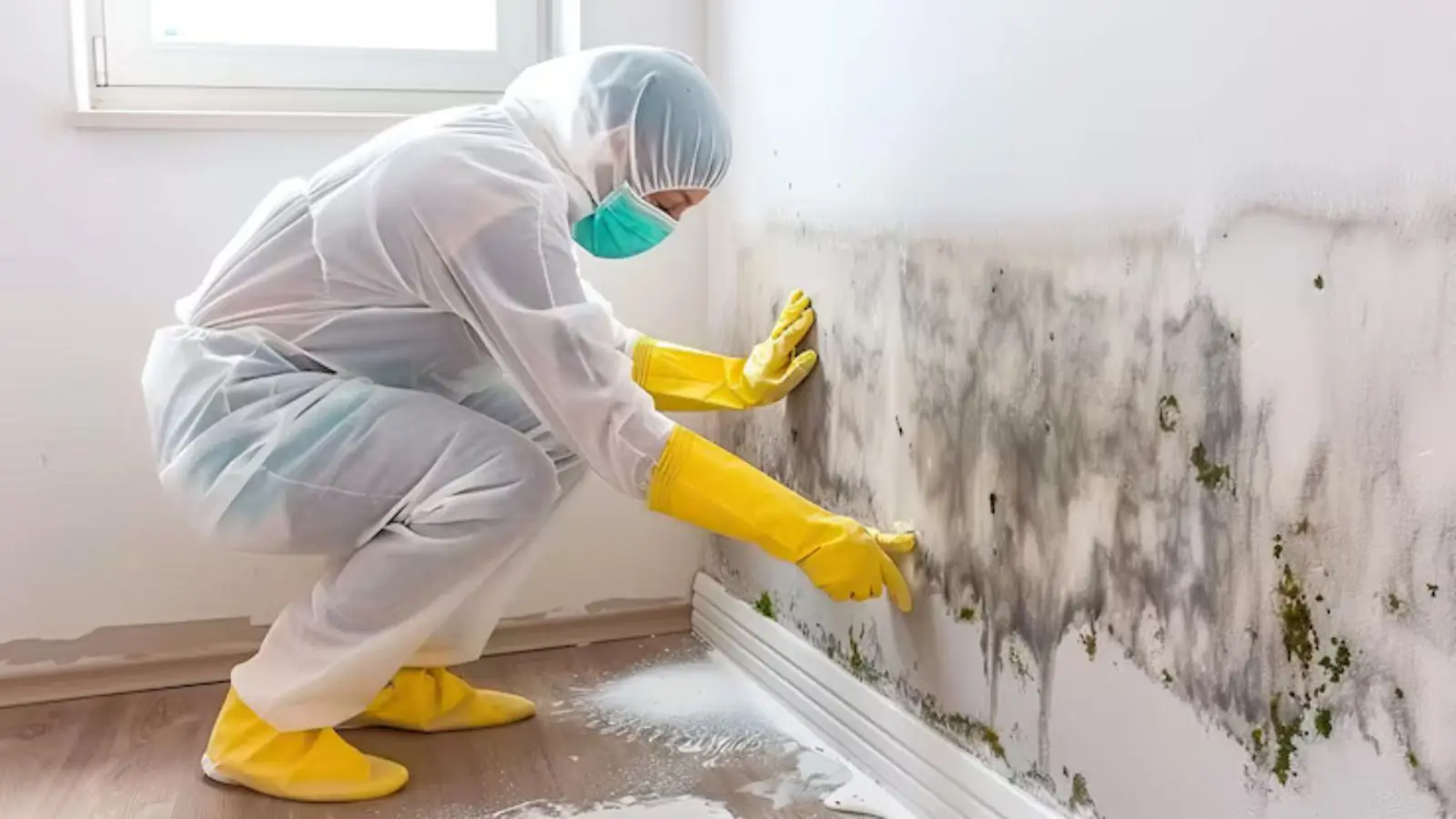
Mold clean up is one of the few water damage jobs where a homeowner can legitimately do part of the work. The EPA says small mold areas of about 10 square feet or less can generally be handled by the homeowner, and larger areas call for professional guidance. That line is useful, but it only holds when the surface is hard, the area is truly small, and the moisture problem is solved.
This guide explains what you can clean yourself, what has to be cut out, how to set up basic containment, and what a professional job adds. It also covers the step most people skip, which is fixing the water source first. Mold needs moisture, and any cleanup that ignores the moisture is a temporary one.
The 10 square foot guideline, read honestly
Ten square feet is roughly a three-foot by three-foot patch. The EPA offers it as a practical dividing line in its guide to mold, moisture and your home, not as a promise that anything under it is trivial. Plenty of small visible patches sit on a larger wet area behind a wall or under flooring.
Use the guideline as a first filter, then ask three more questions. Is the material hard and non-porous? Do you know exactly where the water came from, and is it stopped? Can you reach all of the affected area without opening a wall? If any answer is no, the job has probably outgrown a weekend of scrubbing.
What you can clean and what has to be removed
The deciding factor is porosity. Hard, sealed surfaces can be cleaned because growth sits on top. Porous materials absorb moisture and growth into their structure, so surface cleaning does not reach all of it.
| Material type | Examples | Typical approach |
|---|---|---|
| Non-porous | Glass, metal, glazed tile, sealed counters | Homeowner can clean with detergent and water, then dry fully |
| Semi-porous | Solid wood framing, unsealed concrete | Professional cleaning, often with HEPA vacuuming and wire brushing |
| Porous | Drywall, ceiling tile, carpet, pad, insulation | Usually removed, bagged and replaced |
A hard rule helps here. If a porous item is visibly affected and was wet for days, plan to replace it rather than clean it. Painting over it hides the problem and leaves the moisture and the material in place.
Water in the house right now? Our dispatch line is open 24/7.
☎ Call (626) 879-0276Fix the moisture first
Cleaning without fixing the source is the most common reason people redo the same job. Start by finding where the water came from. Typical sources include a failed toilet supply line, a slow sink drain, an air conditioner condensate line, a roof leak or a window seal.
Once the source is repaired, dry the area completely. A moisture meter gives a number for drywall and wood, and a dehumidifier plus fans help with the air. If you cannot find the source or confirm the structure is dry, call before you clean. A plumber handles the repair, and restoration handles the drying and the cleanup around it, including repair after mold removal when walls or flooring come out.
Containment basics for a small DIY job
If your patch is small, hard-surfaced and well understood, basic containment keeps spores from spreading to other rooms. This is the minimum, and it is not the same as a professional setup.
- Close off the room with plastic sheeting taped to the door frame, and shut the heating and cooling vents inside it.
- Wear gloves, eye protection and a respirator rated at least N95, as EPA guidance suggests for cleanup.
- Wipe with detergent and water instead of dry brushing, which sends particles into the air.
- Bag waste in heavy plastic, seal the bag, and wipe the outside before carrying it through the house.
- Dry the area completely, then wet-wipe nearby surfaces and use a HEPA vacuum if you have one.
- Never mix cleaning products, and keep the room ventilated while you work.
Stop if you uncover more than you expected. A patch that grows from a hand-sized spot to a wall section on removal has just moved into professional territory.
What professional mold cleanup involves
Professional work follows ANSI/IICRC S520, the published standard for mold remediation. In California, mold cleanup must also follow EPA and Cal/OSHA rules for safe removal and disposal, according to the LA County Department of Consumer and Business Affairs. A typical job moves through these stages.
- Assessment and moisture mapping with meters and a thermal imaging camera to find the extent and the source.
- Containment barriers with a negative air machine, so air flows into the work area and out through HEPA filtration.
- Controlled removal of porous materials that cannot be cleaned, bagged inside the containment.
- HEPA vacuuming and damp wiping of remaining surfaces, with cleaning of framing as the materials allow.
- Drying to verified readings, then a check that the work area meets the goals set in the scope.
- Rebuild afterward, which is restoration rather than remediation. The county guide separates the two, because remediation removes hazards and restoration repairs finishes.
Our mold remediation service follows this sequence. We cannot promise that mold will never return anywhere in a home, because that depends on moisture the home sees in the future. We can explain what was removed, what was dried and what to watch.
A quick decision guide
Use this as a gut check before you pick up a sponge.
- Clean it yourself if the patch is under about 10 square feet, sits on a hard sealed surface, and the leak is fixed.
- Call for guidance if the area is larger, the material is porous, or you smell mold with nothing visible.
- Call quickly if sewage or contaminated water was involved, if a ceiling is soft, or if you see growth in several rooms.
- Ask a physician about any health concern. A restoration company can describe the house, not the person.
If you are unsure, call (626) 879-0276. A short description of what you see is usually enough to tell you which of these paths fits.
Mold clean up and the City of Temple City
Cleanup that ends with cut-out drywall or new flooring can raise a permit question, and the answer varies by job. The city's Building & Safety division reviews plans, issues permits and inspects construction, with its permit counter open Monday to Thursday, 8:00 to 11:30 AM and 1:30 to 4:30 PM. Call (626) 285-0488 before you schedule the rebuild, so you do not stall a finished cleanup waiting on paperwork.
Temple City sits close to Arcadia, about 2 miles northeast, and El Monte, about 4 miles southeast. If your home is near either border, our pages on water damage restoration in Arcadia and mold and water help in El Monte describe those service areas, which helps you confirm coverage before you call.
Frequently asked questions
Bleach is not a substitute for removing moisture, and it does not make porous materials safe to keep. On hard surfaces, detergent and water with thorough drying is a common approach. Never mix bleach with other cleaners, and ask a professional or your physician if you have safety concerns about products.
It is about a three-foot by three-foot patch. That is the EPA's rough limit for homeowner cleanup. If the patch is near that size, or if it sits on drywall or carpet, treat it as a job that needs a professional opinion.
Basic containment is sensible even for small patches. Seal the room with plastic sheeting, wet-wipe instead of dry brushing, and bag waste before moving it. Larger areas call for professional barriers and negative air machines with HEPA filtration.
Usually the moisture source was never fixed, or the material stayed damp. Mold needs moisture, so a hidden leak, poor ventilation or a wet cavity can let growth restart. A moisture meter reading and a leak repair tell you more than another round of scrubbing.
Permit rules vary by job, so ask the city Building & Safety division at (626) 285-0488 before you start. The division reviews plans, issues permits and inspects construction, and inspections run Monday to Thursday. A permit is valid six months once issued, so schedule the rebuild with that in mind.
Questions about your home? Talk to the 24/7 dispatch line.
☎ Call (626) 879-0276