
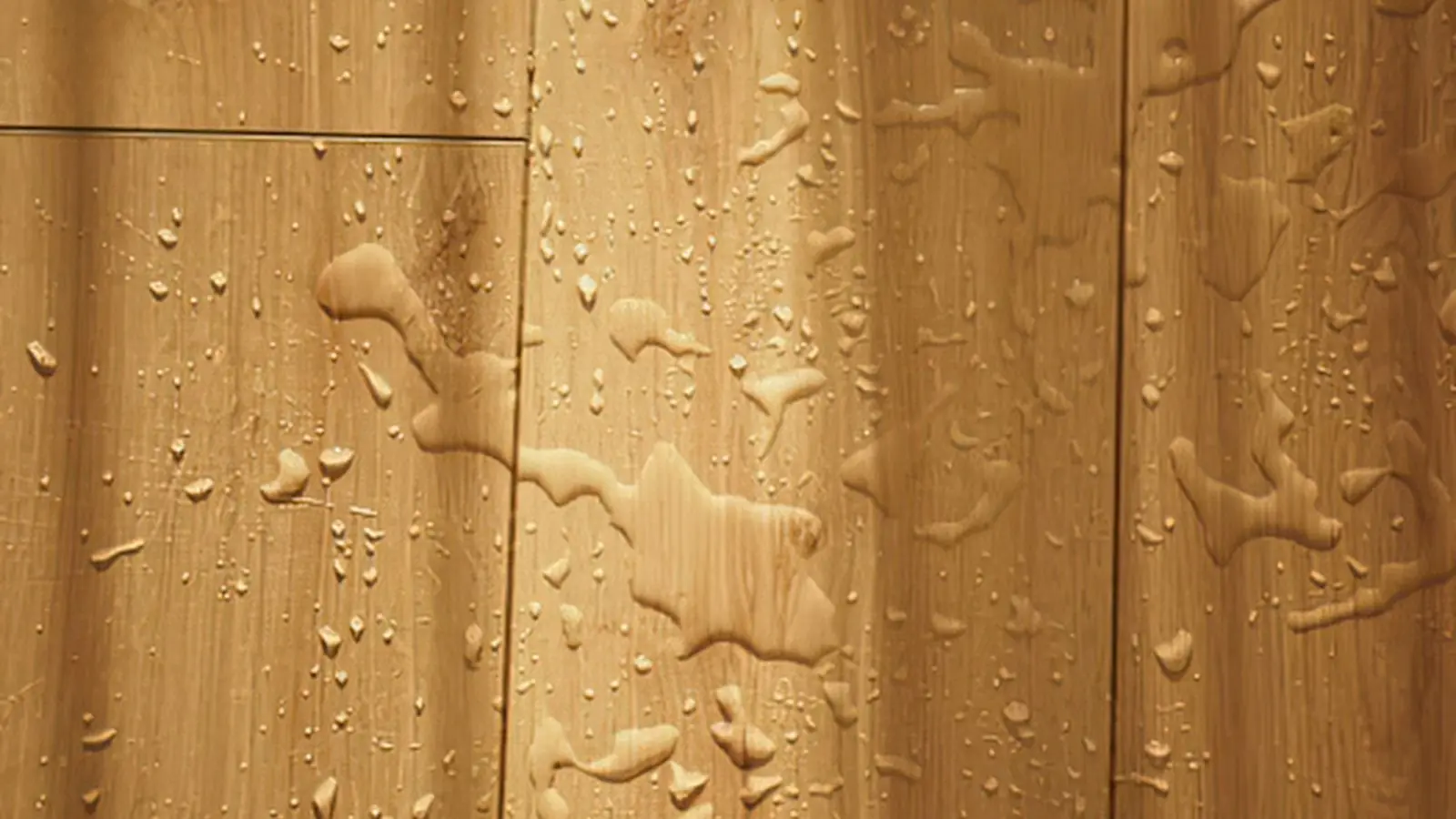
Hardwood is wood, and wood drinks water. After a leak, a dishwasher failure or a washer hose burst, boards swell, edges curl and the floor that looked fine last week starts to ripple. The question you need answered is whether the floor can be dried and saved or has to be pulled up.
This guide explains water damage on a hardwood floor in plain terms: the three shapes damage takes, what drying mats and dehumidifiers do, why you wait for the boards to flatten before sanding, and when replacement is the honest answer.
Cupping, crowning and buckling: what each one means
The shape of the damage tells you what happened and how far it has gone. Wood absorbs moisture faster on the underside than the top, so the boards bend toward the wet side.
| Term | What it looks like | What it usually means |
|---|---|---|
| Cupping | Board edges rise higher than the center, like a shallow dish | Moisture from below or a spill that soaked the underside. Often recoverable if dried promptly |
| Crowning | The center rises higher than the edges | Often follows cupping after sanding too soon, or moisture that dried unevenly from the top |
| Buckling | Boards lift off the subfloor, sometimes in tall ridges | Heavy, prolonged water. Boards often have to be replaced, and the subfloor needs inspection |
| Gaps and staining | Boards shrink apart or turn dark gray or black | Dry-out after earlier swelling, or long-term moisture. Dark staining is hard to remove |
Cupping is the one most homeowners meet first, and it is also the one with the best chance of recovery when the floor is dried fast and correctly.
What to do in the first day
Speed matters more with hardwood than with almost any other finish. Every hour the boards stay wet, they swell and the finish loses its seal.
- Stop the water at its source. Close the fixture valve or the main valve if you can't tell where it's coming from.
- Remove standing water with a wet vacuum or towels, and lift rugs, mats and furniture off the surface.
- Pull baseboard or shoe molding only if it can come off cleanly, so air can reach the edge gap.
- Run fans and the air conditioner to move air, and use a dehumidifier if you have one. Don't use a heater or floor heat to speed things up, because forced heat can crack boards.
- Photograph the floor and take readings with a moisture meter if you own one.
- Call a restoration company, because wood floors usually need more drying than household fans can provide.
The EPA says drying wet materials within 24 to 48 hours of a leak usually prevents mold growth, and that mold needs moisture to grow. Hardwood trapped under finish dries slowly, which is why professional equipment is worth considering.
Water in the house right now? Our dispatch line is open 24/7.
☎ Call (626) 879-0276How professionals dry a wet hardwood floor
A crew starts with a moisture meter and compares readings against a dry piece of the same flooring in an unaffected room. That reference sets the goal. A thermal imaging camera can also show wet zones under the finish without opening anything.
From there, the standard equipment is a floor drying system. Drying mats or panels lie over the boards and pull moisture out through suction or controlled air flow, while air movers and an LGR dehumidifier carry the moisture out of the room. Crews often drill small relief holes or lift a few boards in problem areas so air can reach the subfloor and cavity underneath. Our water mitigation service page describes that drying stage in more detail.
Drying takes days, not hours, and the crew rechecks readings daily. The work follows ANSI/IICRC S500, the published standard for water damage restoration. Ask any company whether its crews work to it.
Why you wait for flattening before sanding
Sanding a cupped floor feels like the obvious fix, and it is the most common way to make damage permanent. If you sand while the boards are still swollen, you cut the raised edges flat. When the wood then finishes drying and shrinks, the center sits higher than the edges, and you have a crowned floor with less wood left to work with.
Let the floor dry fully and stabilize, which can take weeks, and then check it again. Many cupped floors relax and flatten as moisture equalizes. Sand and refinish only after the meter reads close to a dry reference and the boards have stopped moving.
- Check readings on several boards, not just one.
- Look at the floor in low-angle light to see if the surface is flat.
- If the floor still looks wavy after drying, a flooring contractor can judge if sanding will work.
When boards have to be replaced
Replacement is the honest answer in a few cases. Buckled boards that lifted off the subfloor rarely settle back down. Boards stained dark by long exposure, softened or showing mold growth cannot be cleaned to look new. Engineered flooring with a swollen core, or laminate that looks like wood, usually has to be replaced when it has wet, since the layers separate.
Subfloor matters too. A subfloor that stays damp under replaced boards causes the new floor to cup, so a good crew checks and dries it first. If dark growth appears, mold remediation to the S520 standard has to happen before new boards go down.
Refinishing last, and getting the match right
Refinishing is the final step, not the first. After drying, any replaced boards are nailed in, sanded level with the existing floor and stained to match. Finish color often varies by room, so most refinishers sand and coat the whole room, or at least continuous runs of boards, so you don't end up with a visible patch.
Water damage repair is separate from drying, and the rebuilding scope should be written out before it starts. Our water damage repair page covers how restoration and rebuilding fit together. Call (626) 879-0276 if your floor has started to cup and you want to talk through drying before anything else.
Insurance and documentation
Sudden and accidental water damage, such as a burst supply line or a failed appliance, is often covered by homeowners insurance. Gradual leaks and neglect often are not, and flood damage is usually excluded and needs separate flood coverage. Check your policy and ask your insurer. Photos, moisture readings and a written scope make the claim clearer.
Hardwood floors in Temple City
Temple City sits at the base of the San Gabriel Mountains at about 400 feet. If the water that reached your floor came from outside, such as runoff through a door or garage, a standard homeowners policy does not cover flood damage, per the California Department of Insurance. Check the FEMA Flood Map Service Center at msc.fema.gov for your address, and ask LA County Public Works about drainage near you.
Readers in San Marino, where most homes date from 1920 to 1950, can read about our San Marino water damage work. Those in San Gabriel, about 2 miles southwest of Temple City, can find us on our San Gabriel page. If your home is that age, ask a flooring contractor to judge the floor after drying.
Frequently asked questions
Often it will, if the source is fixed and the boards dry slowly and fully. This can take weeks. Don't sand until the moisture readings are near a dry reference and the boards have stopped moving.
Usually days of active drying with mats, air movers and a dehumidifier, followed by a wait for the wood to stabilize. The exact time depends on how long the boards were wet, the species, the finish and the subfloor beneath.
Fans and a dehumidifier help in a small spill, but heaters can crack boards by drying the surface too fast. A moisture meter should confirm the floor is dry. Larger or older spills usually need professional drying equipment.
Buckled boards usually have to be replaced, because they have separated from the subfloor and often lost shape. A subfloor inspection is part of the job, since moisture trapped underneath will damage the new boards.
Yes. Standard homeowners policies typically exclude flood, and flood coverage through the National Flood Insurance Program generally takes effect 30 days after purchase. Check msc.fema.gov for your address and call your insurer or agent.
Questions about your home? Talk to the 24/7 dispatch line.
☎ Call (626) 879-0276