
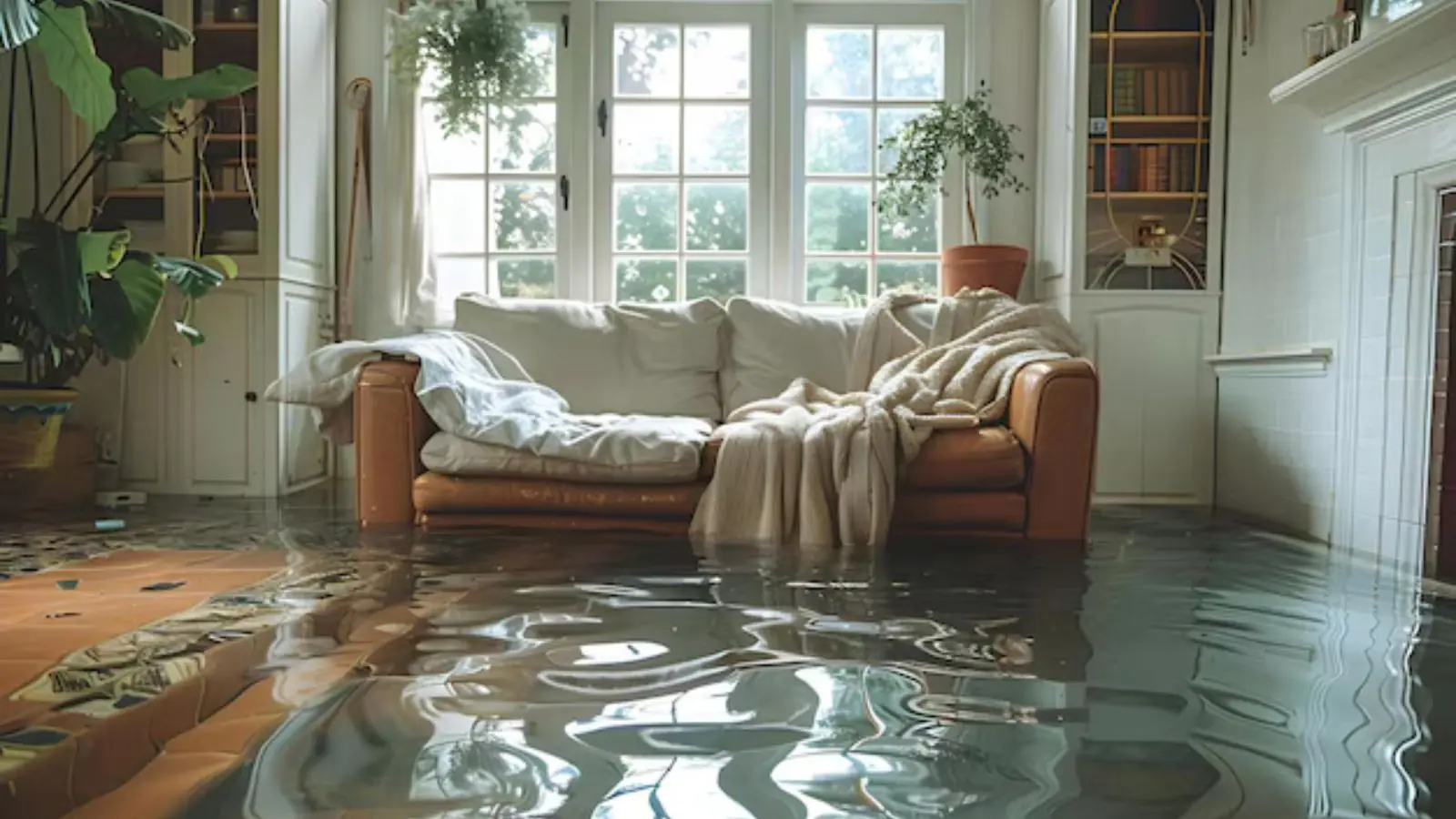
Fixing flood damage is a sequence, and the order matters. Skip safety and you risk injury. Skip documentation and you weaken an insurance claim. Skip the drying and you invite mold and structural problems. This guide walks through the steps in the order a restoration job actually runs.
It also separates two events people often lump together, a flood and a sudden pipe burst, because insurance treats them very differently. Nothing here replaces your policy or your insurer. Use it as a map, then call for an on-site assessment when water has reached the house.
Flood or burst pipe? Why the label matters
The source of the water changes both the cleanup and the insurance picture. Standard homeowners policies typically exclude flood, mudslide and debris flow, according to the California Department of Insurance. Sudden and accidental damage inside the home is often covered, and gradual leaks and neglect often are not. Check your policy and ask your insurer.
| Event | Typical water category | Usual insurance pattern |
|---|---|---|
| Burst supply pipe inside the house | Category 1 at first, can worsen with time | Sudden and accidental damage is often covered, check your policy |
| Water rising from outside or runoff | Category 3 | Flood is usually excluded and needs separate flood coverage |
| Sewage backup from a drain | Category 3 | Varies by policy, ask your insurer |
| Slow leak over weeks | Category 1 to 2 | Gradual leaks are often not covered |
The category is a starting point, not a final label. Water that begins clean can become contaminated as it sits, which is why a professional assessment looks at the actual conditions.
Step one: safety before anything else
Water and electricity are the first hazard. Do not walk into standing water if it may touch outlets, cords or the panel.
- Turn off power to wet areas only if you can reach the panel while standing dry. If water is near the panel, stay out and call the utility or 911 before calling us.
- If you smell gas, leave the house and call the gas utility or 911.
- Shut off the main water valve if the source is a broken line inside the house.
- Keep people and pets out of any water that may be contaminated, including sewage or floodwater.
- Wear boots and gloves if you must enter, and do not use household appliances while the floor is wet.
For standing water or fast-moving leaks, our emergency water removal service is set up for same-day and after-hours calls. We cannot promise an arrival time, but we will tell you what to do while you wait.
Water in the house right now? Our dispatch line is open 24/7.
☎ Call (626) 879-0276Step two: document for the insurer
Take photos and video of the water level, the damaged rooms, the contents and the source before anything moves. Write down the date and time you noticed the problem. Keep receipts for any emergency expenses.
Documentation continues through the job. Moisture readings from a restoration crew, a written scope of work and photos of materials that were removed all help your insurer review the claim. They do not guarantee approval, and we do not promise one. They simply give the claim something concrete to rest on.
Step three: identify the water category and class
ANSI/IICRC S500, the published standard for professional water damage restoration, sorts water by contamination and damage by how much material is wet. The category sets the method, because contaminated water changes what can be saved.
- Category 1: clean source, such as a supply line.
- Category 2: significant contamination, such as a washing machine overflow.
- Category 3: grossly contaminated, such as sewage or floodwater.
- Classes 1 to 4: how much of the structure and contents are wet, from a small area to deep saturation of dense materials.
Floodwater is usually treated as Category 3. Porous materials that soaked in it, such as carpet, pad and drywall, are normally removed rather than dried. Ask any company whether its crews work to S500 and how it decides what is saved.
Step four: extraction, tear-out and drying
Extraction comes first. Truck-mounted and portable extraction units pull standing water from floors, and the sooner this happens the less water soaks into materials. After that the crew decides what has to come out.
- Tear-out: remove porous materials that cannot be dried or cleaned safely, often including the lower portion of drywall, baseboards, pad and insulation.
- Moisture mapping: use moisture meters and a thermal imaging camera to find water inside walls and subfloors.
- Drying: place air movers and LGR dehumidifiers, and monitor readings daily until structure and framing reach dry standards.
- Documentation: record the readings so you can show the job was dried to targets rather than to feel.
Drying is not waterproofing. It does not stop future water from entering, and it does not fix grading or drainage. Those are separate projects, and a restoration company is not the right trade for them. See our flood damage restoration service for how the steps fit together.
Step five: sanitizing and rebuild
Once the structure is dry, surfaces that touched contaminated water are cleaned and treated with antimicrobial products where appropriate. Dehumidification continues until readings confirm the space is dry. This stage closes the remediation side of the job.
Rebuild is restoration, which repairs drywall, flooring, trim and paint. The county guide separates remediation, which removes hazards, from restoration, which rebuilds. Expect a separate scope for the rebuild, and ask whether permits apply, since permit rules vary by job.
Flood insurance and the FEMA map
Flood insurance comes through the National Flood Insurance Program, a FEMA program, through licensed agents or Write Your Own insurers. The policy generally takes effect 30 days after purchase, with an exception when a mortgage lender requires coverage in a high-risk area. The California Department of Insurance notes it does not regulate the NFIP.
To see your flood exposure, check the FEMA Flood Map Service Center at msc.fema.gov for your address, and ask LA County Public Works or your city about drainage near you. Buying after a flood happens will not help that event, so the time to look is before water arrives. If water is in your house now, call (626) 879-0276 and we will explain the next steps.
Flood damage in Temple City: what to check
Temple City sits at the base of the San Gabriel Mountains at about 400 feet in elevation. That setting is not a flood forecast, so do not assume your address is safe or at risk. Look up your address at msc.fema.gov and ask LA County Public Works or the city about drainage near your street, then decide on flood coverage while the 30 day wait is still ahead of you.
Golden State Water's San Gabriel service area covers portions of Temple City, but not every address. Check your water bill for the supplier so you know whom to call about a main shutoff when the break is outside the house. If you live near the city's southern or eastern edge, our pages for water damage restoration in Rosemead and water damage restoration in El Monte cover those neighboring areas.
Frequently asked questions
Standard homeowners policies typically exclude flood, mudslide and debris flow, according to the California Department of Insurance. Flood coverage is separate and usually comes through the National Flood Insurance Program. Check your policy and ask your insurer about your specific situation.
A policy through the NFIP generally takes effect 30 days after purchase. The exception is when a mortgage lender requires coverage in a high-risk area. That is why checking your exposure before a storm matters more than checking during one.
Under ANSI/IICRC S500, Category 1 is a clean source, Category 2 has significant contamination, and Category 3 is grossly contaminated, such as sewage or floodwater. The category changes what can be dried and what must be removed.
Small, clean spills sometimes can be handled with towels, fans and a dehumidifier. Floodwater is usually Category 3, and porous materials soaked in it are normally removed. Hidden moisture in walls is hard to find without meters and a thermal imaging camera.
We cannot tell you from here. Enter your address at the FEMA Flood Map Service Center, msc.fema.gov, and ask LA County Public Works or the city about drainage near you. Do not guess in either direction. The map result also tells you whether a mortgage lender might require flood coverage.
Questions about your home? Talk to the 24/7 dispatch line.
☎ Call (626) 879-0276