
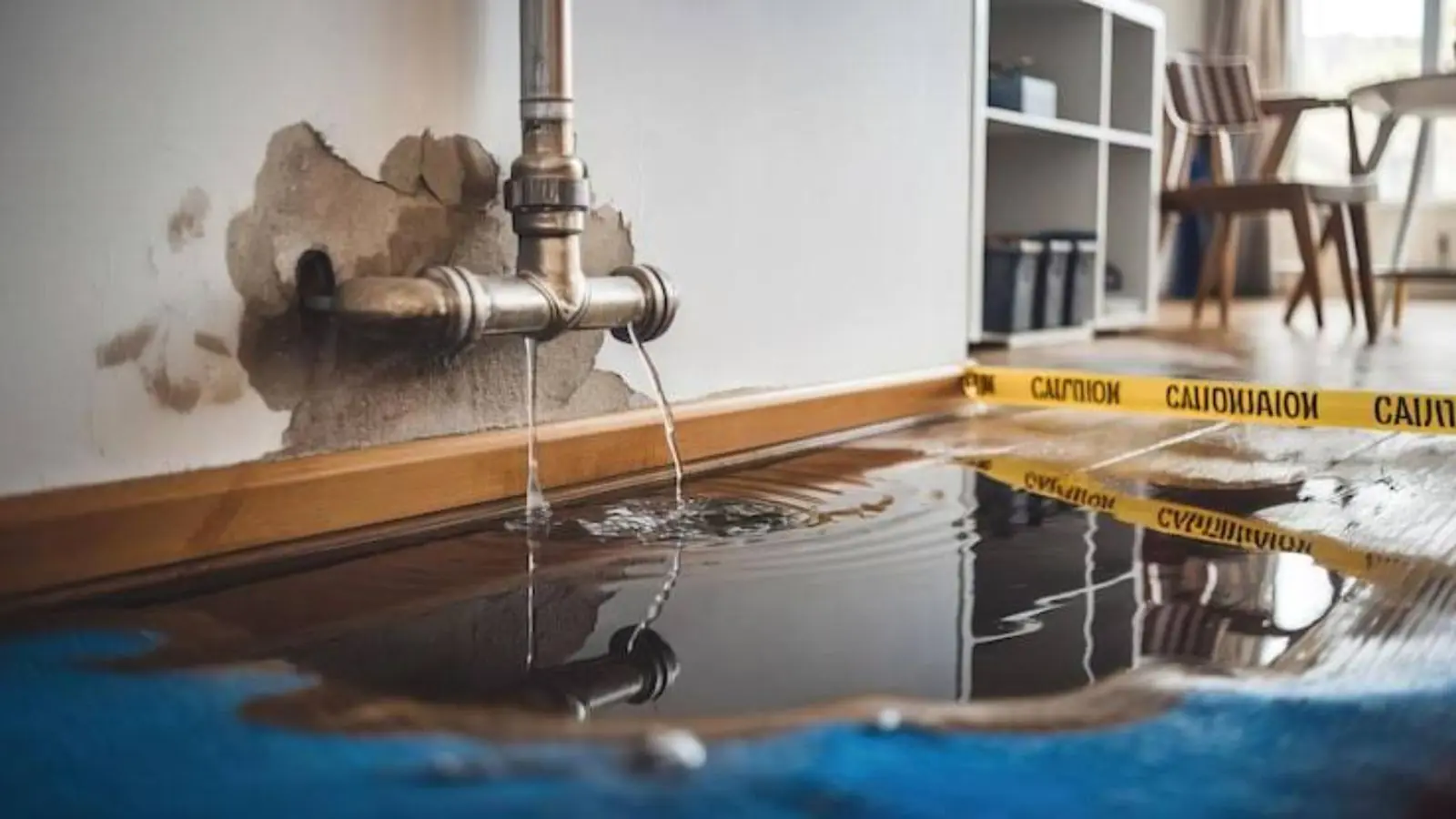
If water is running right now, stop reading and shut off the main water valve. Then come back. Every minute a pipe runs adds to the wet area, and the single most useful thing you can do is stop the supply. When you're ready, (626) 879-0276 reaches 24/7 dispatch for the water side of the problem.
The steps below are in order. Some take a minute, some take longer, and a few depend on whether it's safe to reach the electrical panel. Where there's doubt, stay out and call the utility or 911 first. A pipe can be fixed. People are harder to repair.
Step by step: the first 15 minutes
Work through these in order, stopping at any step that isn't safe.
- Shut off the main water valve. This is the step that stops new water from arriving.
- Look at the electrical situation. If water is near outlets, appliances or the panel, don't touch them. Cut power to wet areas only if you can reach the panel while standing dry.
- Open the lowest faucets in the house, and flush a toilet or two, to drain pressure and residual water from the lines.
- Move valuables, electronics, rugs and small furniture out of the wet area or up onto dry surfaces.
- Keep people and pets out of standing water, especially if it might be contaminated.
- Take photos and a short video of the damage and the failed pipe before anything is moved.
- Call a plumber for the pipe and a restoration company for the water.
If the water came from a sewer line or drain backup, treat it as contaminated and skip the cleanup. If you smell gas or see sparks, leave the house and call 911.
How to find your main water shutoff
Every home is a little different, so locate the shutoff before you need it. The main valve is usually where the water line enters the house. Common spots include near an outdoor hose bib, in a garage or utility closet, near the water heater, or in a basement or crawl space where one exists.
A round wheel handle is a gate valve and turns clockwise to close. A lever handle is a ball valve, and a quarter turn closes it. If the house valve is stuck, leaking or can't be found, the meter near the street has a utility shutoff, but that's usually for the water company to operate.
Water in the house right now? Our dispatch line is open 24/7.
☎ Call (626) 879-0276Who to call: the plumber, the restoration company, or both
A burst pipe creates two separate problems, and they need two kinds of help. Mixing them up is the most common source of delay.
| The problem | Who handles it | What they do |
|---|---|---|
| The failed pipe, fitting or fixture | Licensed plumber | Locates the break, repairs or replaces the pipe |
| Standing water on floors | Restoration company | Extracts water with portable or truck-mounted units |
| Wet walls, floors and ceilings | Restoration company | Maps moisture, removes unsalvageable materials, runs air movers and LGR dehumidifiers |
| Water from outside your house, such as the street side of the meter | Your water supplier | Handles the supply line up to and including the meter |
| Coverage questions | Your insurer or agent | Explains what your policy covers |
Restoration doesn't repair plumbing, so don't wait on the plumber's schedule to start drying if the water is already stopped. If you're outside Temple City, we also cover water damage restoration in Rosemead and water damage restoration in Arcadia.
What gets opened up, and why
Homeowners are often surprised when a crew cuts into a wall that looks fine. The reason is simple. Water travels through wall cavities, under baseboards and beneath flooring, and a thermal imaging camera or moisture meter can show wet areas the eye can't see.
Typical openings include removing baseboards, drilling small holes to let air into a wall cavity, cutting drywall a foot or two above the wet line, and lifting wet carpet and pad. Soaked insulation is removed because it holds water and won't dry in place. A good crew explains each opening before cutting. Rebuilding those areas afterward is covered on our water damage cleanup and water damage repair pages.
Signs of a hidden leak behind walls
Not every burst pipe announces itself with a flood. Slow failures can run for weeks inside a wall or under a slab before anything shows.
- A water bill that rises with no change in how you use water
- The sound of running water when every fixture is off
- Paint that bubbles, peels or stains in a spreading patch
- Baseboards or flooring that warp, cup or lift
- A musty smell in one room that doesn't go away
- A warm spot on the floor, which can point to a hot water line
If you see any of these, shut off the water at the main and watch the meter or your fixtures. A leak detection visit from a plumber can confirm where it is. Slow leaks matter for insurance, since gradual damage is often excluded, so check your policy.
What not to do
These mistakes make a bad day worse, and most come from understandable instincts.
When you compare restoration companies, ask whether their crews work to ANSI/IICRC S500, the published water damage restoration standard, and check any contractor's license at cslb.ca.gov before you sign.
- Don't wade into standing water near outlets, cords or the panel.
- Don't use a household vacuum on water. A wet vac is built for it and a regular one isn't.
- Don't assume the damage is done once the floor looks dry. Wall cavities and subfloors hold moisture longer.
- Don't throw out damaged items before photographing them.
- Don't wait for the adjuster before limiting the damage. Many policies expect you to act.
- Don't sign a contract that doesn't state the scope, the price and the CSLB license number.
On insurance, sudden and accidental pipe bursts are often covered and gradual leaks often are not. Check your policy, keep your photos and moisture readings, and ask your insurer what it needs.
Burst Pipes and Water Service in Temple City
Golden State Water Company's San Gabriel service area covers portions of Temple City, but not every address. Check your water bill to find out who supplies you. That matters in a pipe emergency because if the problem is on the street side of your meter, or you can't close your house valve, the supplier on your bill is who to call.
If a plumber recommends replacing a section of pipe, ask whether the work needs a permit. The city's Building & Safety division handles permits for plumbing work, and its permit counter is open Monday to Thursday, 8:00 to 11:30 AM and 1:30 to 4:30 PM. Call (626) 285-0488 on a weekday, since permit rules vary by job and your plumber may need the answer before scheduling.
Frequently asked questions
There's no safe number, because it depends on the pipe, the water pressure and your floors. Even a short run can soak drywall and flooring. The EPA notes that drying wet materials within 24 to 48 hours usually prevents mold growth, so get help moving quickly.
Only if you can reach the panel while standing completely dry and the panel itself hasn't gotten wet. If water has reached the panel or outlets, stay out and call your utility or 911 first. Never touch electrical equipment while standing in water.
The source has to be stopped first, which may be as simple as closing the main valve. A plumber is needed to repair the pipe, but extraction and drying can usually begin once the water is off.
Sudden and accidental pipe failures are often covered, while gradual leaks and neglect often are not. Whether the pipe itself is included varies. Check your policy and ask your insurer, and keep photos and moisture readings.
Check your water bill to see who supplies you, because Golden State Water covers portions of Temple City but not every address. Call that supplier's service line and explain that you can't close your house valve. They can tell you what they will and won't do.
Questions about your home? Talk to the 24/7 dispatch line.
☎ Call (626) 879-0276